Originally published in
PanelXPanel #18.
To Lapis, for being an inspiration.
“Now he looked up at the absolute darkness above him and tried to scream, but it came out as a long, rattling choke.
Next time he’d stay home.
Next time. As if there were wars in Heaven or Hell, as if there was another battlefield he’d find himself on.”
-Paul Cornell, Human Nature

“For those of you who have not read this book before: there is a story here, as you turn these pages, called Carcassone; a story of an endless search, a quest with no conclusion or reward. When I first read the story I showed it to those around me; to friends, to family. They found it sad and wistful, but I found something different in it. I found it to be a story of the greatest hope, because it was a story of not giving up long, long after hope was gone. To some it was a story of futility, but to me it was a story of refusing to abandon the thing you must do, even if you realize that it may be futile. It was a story of striving, and striving was the point: not the path, the plot, or the means to an end.
It’s a story I call to mind whenever my days are too heavy, whenever the struggle’s too much, whenever it would be easier to accept the world as it is rather than as it should be.”
-James Portnow on Carcassone by Lord Dunsany
There are two reasons why this comic is important to me.
The first requires some context. I realized I had to structure article the way it is while I was staying at my Nonna’s Florida condo in February 2018. Ever since my Poppi died last year, members of the family have been taking turns spending time with her, especially when she goes down to Florida for the winter. It was about eight at night when my mom called to check up on us. She wanted to know how her mother was doing, how I was doing, and other such things. For some reason, I was in a bit of a funk at that time. I had just finished a session of editing books for a publisher I work for when she called, and for some reason I was thinking morose thoughts. When she noticed that I was in a funk, my mom asked what was the matter. I couldn’t articulate in my head what was the matter, so I just let my mouth run, a tactic that usually ends poorly for me. From what I recall, I said something along the lines of “I’ve been working on this series of reviews about this comic, Mister Miracle. It’s… well, it’s essentially about what happens after Space Jesus fails to kill himself. And I’ve been thinking about how I’m going to end it. I know, I know, the series doesn’t end until September, but I like to think about these things well in advanced. And…I think I’m going to have to write about my history with, for lack of a better term, neurodivergency.”
This didn’t come completely out of nowhere. There was an ulterior motive to us spending time with Nonna beyond keeping her from being completely isolated: Nonna’s in the early stages of dementia. She’s not at the stage where she starts to forget who family members are or thinks that it’s 1968 or something. But there are moments where she seems… lost. Not in the sense where she doesn’t know where she is in the moment, but that she doesn’t know where she is in her life. She’ll think that events that had happened yesterday are coming up. I’ll have to tell her what we’re doing today multiple times within the span of an hour. My Nonna will sometimes forget my name and call me “George” or “Patrick.” And caring for her that week pushed me towards that revelation.
In many ways, I was the last one to find out about this precisely because these are things everyone does from time to time and I thought my family was just making a mountain out of a molehill. Then I spent a week with her. It was… I have this thing where I can’t watch movies or TV shows that have an “It’s a Wonderful Life” plot, a story wherein the main character finds themselves in a world very much akin to their own world, but off. It’s wrong in a way that no one else can understand. And they’re just interacting with people who are confused that this person thinks the world is wrong because it doesn’t match their view of it. It feels a bit close to home watching people be belittled by their friends for seeing the world differently. For the first time in my whole life, I felt like I was one of those friends when I was around my Nonna in Florida.
I’m on the autism spectrum. Specifically, I’m on the end wherein I could pass for a neurotypical person. I don’t have the obsessions with trains or dinosaurs that people say all autistic people have (though I do have a fondness for trains). I do have my obsessions, though I can drop them at a moment’s notice with nary a look back. I don’t have a difficulty speaking, but I do have trouble expressing what I mean, if that makes sense. I notice things that other people don’t and miss what others see clearly. I have somewhat of a “neat freak” streak mixed with a slight hint of messiness where everything has to be in its proper place, even if it’s on the floor. At times, I’ll act like an antisocial jerk, but more often than not I collapse inward into a numbness when I realize how I’ve hurt other people. I couldn’t cry when my grandfather was in the hospital. (Sometimes I joke to myself that while normal people cope by crying and letting their emotions out, I coped by writing a book of literary criticism.) I felt sad, certainly. There was a numbness that it was all over and done with, that he was gone. But I didn’t cry.
I’d have anxieties that I was misdiagnosed as autistic because I didn’t feel like the ones you see on TV. I looked to be more akin to a sociopath: someone who doesn’t care about other people, who looks at others like they’re just meat. I felt awful when this thought first came to me. I brought this up to one of my high school teachers, and they pointed out that the fact that these thoughts make me feel terrible is a sign that I’m not a sociopath. Maybe they were just trying to get a student to calm down, but it was after class at the end of the school day. Regardless, in the years since that moment, I’ve learned more about neurodivergency and how to express the words that I’ve been living with for my whole life. I sometimes feel like I still don’t have the right words for what I’m trying to say and end up just having my foot in my mouth. I’ve always been open about my autism to people, wearing it like a badge of honor. Though maybe that was more out of a need to beat people to the punch so they don’t use it as a cudgel.
…There’s a bit about me that I haven’t talked about yet. It’s the subsequent thoughts that I had after explaining to my mom why I’m writing it like this, the implications of tying this story into my history with neurodivergency. Time to rip off the Band-Aid, I guess. As a kid, I was bullied. I was probably a target because of my autism. It got so bad that, years after the worst of it was over, I would have to spend some time during multiple classes walking the halls just to center myself and not be overwhelmed by the potential cruelty of others and missing classes on some of my favorite subjects. One time, I mistook a desire to play a game of Chopsticks for something sinister. Another time, there was a bit of genuine cruelty directed towards me, and I had to leave the classroom for some time. I could hear the teacher explaining to the class why I went into the halls and berating them for it.
I have most of eighth grade blocked out. I don’t know if it’s because of the bullying I received at the time being that bad… or if something worse happened to me. Maybe one day I will. Maybe I won’t. That isn’t to say that I don’t remember all the terrible things that happened to me. I remember going up to a teacher I had never met, asking him for help, and receiving none. I remember doing a performance of a scene from To Kill A Mockingbird with one of my childhood bullies and hearing from my teacher encourage him to act like he always did because it was “in character.” I remember all the terrible things I did in “retaliation” to my bullies, things I feel ashamed of doing. But most of all, I remember hearing the voice in my head. It was my voice, you understand. It wasn’t these exact words, but it was the idea of these words that I heard my brain speak. I asked myself
Why shouldn’t I commit suicide?
I would fantasize about hanging myself from the banister, dangling from beside my mother’s bedroom while my feet kicked the ceiling of the hallway behind me. Sometimes I would imagine the necktie I used to hang myself snapping and the fall would kill me. I would imagine leaping in front of a car as it passes by, my guts still within the lifeless husk. I felt… feel uncomfortable around knives, afraid that I would cut myself. I still sometime picture myself leaping in front of trains. Though, more often, I imagine holding onto the train so hard that my arm gets ripped off and I die from blood loss. “Poor sod,” they’ll say, “so desperate to get a ride.”
I should stress that I’ve never actually tried to kill myself. It’s always been more of an intellectual… I want to say exercise, but that feels like I’m dismissing my suicidal tendencies as a mere thought experiment (though I suppose it would explain why I felt so comfortable using the phrase “Why shouldn’t I commit suicide?” as a fucking literary device). I’ve been with therapists and have participated in group therapy. I’ve talked to people who I feel safe talking to about this. And I think now I’m in a better state of mind than I was. But back then, back in eighth grade when these feelings were at their peak, I felt like I was alone in a sea of people.
So what kept me going? Why didn’t I do it? The fact is I got into comics. I always had a fascination with the superhero (especially Spider-Man), but I hadn’t ever ventured into my library’s comics section until middle school. I had seen the trailer for the Watchmen movie they made and, being the kind of kid who read The Divine Comedy in middle school because they made a video game out of Act One, I checked it out to see what the fuss was about. It was a fine comic, though I didn’t really pay much attention to it. I skipped the prose bits and the pirate bits. I just focused on the action. Eventually I moved onto other comics everyone recommended like Sandman or Transmetropolitan or Ultimate Spider-Man, which I read much more closely.
But it wasn’t actually the comics that kept me going. Not really. Sure, they were a factor, but my relationship was when the stories were done and collected in trades. I wasn’t part of the comics community. What did keep me going were the sources of those recommendations. They were from comics and pop culture blogs with weird and interesting ideas. There was Dr. Anj’s Comic Box Commentary, which introduced me to Grant Morrison, and the work of David Brothers and Gavok over on 4thletter, writing about What Ifs and Deadpool and why Before Watchmen is a no good, bad idea; it was Kelly Thompson’s She Has No Head articles and the various interesting people over on Comics Alliance; it was Sequart and Multiversity Comics and the Mindless Ones and all the other one offs I don’t remember, but who nonetheless helped me through this dark period of my life.
But perhaps the most important of all was Andrew Hickey. Hickey is an interesting critic. The majority of his greatest stuff comes from analyzing pop songs from the 1960’s or works of fiction the majority of “traditional critics” would ignore such as fan fiction written by Al Ewing, Doctor Who spin off books, and superhero comics. I likely found out about him through the Mindless Ones (probably the article The Function of The Filth, which is also fantastic) and I went through some of his work. One essay in particular caught my eye. It was an odd essay on the career of Grant Morrison, and in particular his tendency within his long form work to have a larger, more important story intersect with it in the background. The one that’s most focused on is that of Audrey Murray in The Invisibles, a woman who has had a bad life, but she didn’t let that make her a bad person. I didn’t fully grasp the meaning behind the essay at first, but it was an interesting first impression.
But the one that really blew my mind was his essay Morrison’s Mister Miracle miniseries. Without going into full detail, Hickey’s Mister Miracle essay isn’t really about Mister Miracle. The contents of the miniseries barely come up within the text. Rather, it’s two dueling essays dealing with seemingly contradictory themes (one on the history of Pop Music in America and the other on the science of Black Holes) that coalesce into a thematic whole that shines a new light onto the miniseries. In many ways, my critical career has been a long running attempt at aping this style of criticism towards my own ends. That one essay inspired me to get into literary criticism and was one of the many things that led me out of the funk I was in. And I am entirely grateful to Andrew Hickey for that. (So grateful am I that I’m flagrantly ripping off the final chapter of his book, An Incomprehensible Condition [where the aforementioned Mister Miracle essay comes from], for the structure of this essay). So yeah, a story about Mister Miracle dealing with suicidal urges is going to hit close to home.
The second reason is because, when I don’t shave and let my hair grow out, I look exactly like Scott Free (albeit a bit pudgier and with glasses).

“I had a bad year, because I feel like I’m a tough guy, at least that’s how I think of myself. I’ve been overseas, I’ve done some hard things, I fought some wars, but I was broken. I didn’t realize how brittle I was; I couldn’t catch my breath, I’d get weird pains, I couldn’t focus, there was something wrong with me. My hands would start shaking, and amidst all that you have to hit deadlines, you can’t let your kids see that way. And you’re just falling apart on the inside, but on the outside you have to be the dad. But still, you’re shaken, and so for the last two years I have been trying to put myself back together. What’s this about? Was it childhood stuff? Was it being in the war? What violence or discontinuity cracked me? And that process has been revelatory, but the big thing I’ve learned about that process is that is that I’m not alone.
I don’t care if that’s a cliché, I like cliché. I like Batman, and he says, “I’m Batman,” sometimes. But the fact we can reach out to each other, that I can tell somebody, “Look, I used to fight Al-Qaeda, and also sometimes I can’t get my hand to stop shaking.” Those two things can be true. You can be a man and still be weak, and still love your family, and still say that I got to help and I got through this with help. To me, watching my father’s generation run away from that help and embrace ponytails and fast cars when the hit that moment, I feel like we can go a different way, especially in this time of anxiety. We can lean on each other and find a way to fight back all this stuff.”
-Tom King
At its heart, Tom King and Mitch Gerads’ Mister Miracle is a ghost story. This might not seem obvious at first. Sure, a few “ghosts” show up in the first and last chapters of the story (and also the fourth and tenth, depending on how you read those bits), but the majority of the text drops the subject entirely. But that’s only if you assume that a ghost is merely the physical presence of a haunting thing. To quote Guillermo Del Toro, “What is a ghost? A tragedy condemned to repeat itself time and again? An instant of pain, perhaps. Something dead which still seems to be alive. An emotion suspended in time. Like a blurred photograph.”
Given this interpretation of ghosts, the connection to Mister Miracle becomes all too clear: they’re side effects of Scott Free being triggered. This is perhaps best expressed through the first ghost Scott encounters, that of his friend and mentor, Oberon Kurtzberg. But first, we must consider the context he appears in. In the page prior to the appearance of Oberon, Scott and his biological father, Highfather, have a conversation about Darkseid’s discovery of the Anti-Life equation and how it alters the nature of the War. Given that Scott was “infected with the Anti-Life Equation,” one might at first assume that the trigger for Oberon’s appearance would be the aforementioned revelation. However, the key isn’t what is being talked about but rather how it’s being discussed. For all the closeness they share within the images, their words have a level of distance (though the art does depict the distance by having their few moments of intimacy shown from afar). They don’t speak in the tone of a father and son, but of a boss and his subordinate. Highfather certainly cares for Scott, even tries to be fatherly to him. But there’s a sense that he’s only there to tell his son an important detail about the war. (Indeed, during his trial, Scott laments that the two of them weren’t really that close.)
In this regard, this distancing between father and son, do we find the importance of Oberon. Most interpretations of Mister Miracle opt to portray their relationship as two close friends who will have each other’s backs, no matter what. In this tale of escapism though, their relationship is more akin to that of a father and son. Consider the way in which his death is described: of how Scott had decided to pull the plug on Oberon’s life support because he didn’t want him to suffer like that. The tale of a son having to pull the plug on his father is a common one. In many ways, the grief Scott felt over Oberon’s death prior to this book’s beginning is what caused Scott Free to try suicide.
Sure, the text time and time again says that it’s because Scott was infected by the Anti-Life Equation, but let’s consider what that actually is: Loneliness + Alienation + Fear + Despair + (Self – Worth) ÷ Mockery ÷ Condemnation ÷ Misunderstanding X Guilt X Shame X Failure X Judgment. N=Y, where Y=Hope and N=Folly. Love=Lies. Life=Death. Self=Dark Side. The majority of that equation effectively describes what it feels like, both from outside and within, to have depression. The feeling that you’re alone in a sea of people, the fear of what they’ll think of you, the despair that your fears were right. Scott Free was depressed when he slit his wrists. He wanted to escape from the numbness that Oberon’s death made him feel. And so, Scott is haunted by his memory.
The second ghost, that of Granny Goodness, is a bit more complicated to explain. Her appearance could very well be read as a dream, given that both Scott and Barda are asleep when she appears on their television screens. Even if we assume that she is a ghost, which we are, what is the point of such a being if no one can witness her? The answer is quite simple: she’s haunting their dreams. A ghost need not appear in the physical world to have an impact on the mentalities of those who experience its haunting. One of Del Toro’s examples of ghosts was, after all, “an instant of pain.” Time and time again, the trauma of Granny Goodness’ parenting is shown to have been… awful. Throughout this book, her abuse of those in her “care” is shown to us through the testimonial of those who survived it, be it the physical trauma of being trapped in The Judas Cradle or the emotional torment of the Mirror of Goodness. Who wouldn’t have nightmares about that? In some regards, this too is a factor in Scott Free trying to kill himself.
But Big Barda also went through this torment (that’s why Granny’s presence is introduced with both Scott and Big in panel). She also was Granny Raised (or would it be razed?). She didn’t try to kill herself. She was just there clean up the mess Scott’s body and keep things stable enough. She blames herself for Scott’s suicide attempt, despite his reassurances. “When do I get to escape, Scott?!” she asks near the end. Big too wants to escape from the horror and cruelty she suffered, but she doesn’t try suicide. I should note that this isn’t to diminish the trauma and hardship Scott went through that led him to make that decision. Rather, it’s to highlight that just because someone appears to be “normal,” to be perfectly fine and to have their lives in order, that doesn’t mean they too aren’t haunted. In many ways, we’re the most likely to be.
The third ghost is that of Darkseid. Darkseid’s image appears on the glass of a broken picture frame shortly after Scott tried to start talking with Big about the War. About doing to their son what Highfather did to Scott. About giving their child up to Darkseid. His ghostly presence is that of an implication. They don’t even go into the details I brought up from above in that moment. They just say they need to talk about the War, and that’s it. But Darkseid haunts more than just that one moment. Time and again throughout the comic, the phrase “Darkseid is.” appears, interrupting the events just to announce their presence. Sometimes, whole scenes are lost to those words, such as in the penultimate issue, where Big’s defeat at the hands of Darksied is omitted entirely in favor of those words. But what does “Darkseid is.” mean? Scott muses that it probably doesn’t mean anything, it just used because it sounds cool, which is close to the truth. The truth of the mater is, “Darkseid is.” means nothing. That is to say that “Darkseid is.” means there is no meaning in the universe. There is only the void. We are alone, save for those who do not care for us. And the only way out, the only option of escape, is to surrender to Darkseid. These painful, meaninglessly cruel words come to us when we are most vulnerable, as shown with the words interrupting the story at moments of distress (such as shortly before Scott goes off for his execution or when he briefly gives up in the war). They haunt us until we die.
Given these ghosts, its perhaps worthwhile to consider their presence within the final issue. Going in chronological order, Oberon is a tearful farewell. An apology for what Scott tried to do and a reassurance that he’s still a good person. As stated above, Oberon is more of a father in this story, and it is here where this shines the most. Oberon offers not only a shoulder for Scott to cry beautiful, ugly tears, but they share a tenderness toned in a way as to be more fatherly than that of Scott’s initial interaction with Highfather. (Indeed, this final farewell occurs shortly after the ghost of Scott’s own “father” appears. In that moment, Scott rejects Highfather in favor of Oberon on the grounds that he’s a patronizing dick that thinks not giving up your son to Darkseid is a sign of failure.)
Granny Goodness, meanwhile, is something that is still being dealt with. Scott can still hear her nagging and guilt tripping him over his decisions to not leave his family behind. Scott still feels the trauma of his childhood upbringing, both the love he felt for his, for lack of a better term, mother as well as the cruelties she brought upon him. It would be easy if love could never be felt between an abuser and their victim. That there aren’t moments of softness and caring and other such things that make love what it is. But love isn’t inherently good or bad. It just haunts us whenever those who we love aren’t there, even if they were monsters.
As for Darkseid… Darkseid is where Scott is at his most triumphant. His sequence within the final issue is the second shortest in terms of visual appearances of all the ghosts. And unlike Forager, who has the shortest, Darkseid never speaks. He’s just a footstool for Scott at this point, impotent to do anything and eternally miserable. In this way, his ghost shows that traumatic experiences can be overcome. That isn’t to say that all the issues surrounding the trauma are gone, Darkseid is still in psychic landscape after all. Rather, as with many a trauma survivor, Darkseid is a manageable issue rather than a pressing concern. (Indeed, his most lasting presence, the phrase “Darkseid is.” is nowhere to be found, bar a joke at the absurdity of its nature and a rebuke of its implications.)
But there’s one more ghost that needs to be dealt with, one far different than the ones I’ve been talking about. This is a more literary ghost than all the others. I should perhaps explain that. A ghost is a term within literary criticism I made up to refer to the influence you never intended on having. An example of this would be the movie Gremlins 2: The New Batch. It would be a safe bet to say that none of the movers and shakers of the modern age were directly influenced by the movie in their decision making process. Maybe they saw it once, on an airplane while trying to sleep or in the background to distract their kids while they did the adult stuff. They probably don’t remember it at all. And yet, as the days grow more and more carnivalesque, it becomes more and more apparent that Gremlins 2: The New Batch is the most influential movie on the 21
st century. (For a more in depth look at the ways in which Gremlins 2: The New Batch haunts the 21
st Century, please follow
@G2Institute over on twitter) But the ghost that haunts Mister Miracle is that of Grant Morrison and Dave McKean’s A Glass of Water.
Picking a Morrison comic to be the ghost haunting this comic might be a bit odd. After all, the phrase “Darkseid is.” does come from a JLA comic Morrison wrote and King has stated his fondness for the Scottish wanker. But A Glass of Water is different. It was published in the first issue of a black and white anthology series from a publisher no one has ever heard of. Indeed, when I first got my hands on a copy of the story from Dr. Elizabeth Sandifer, a literary critic whose current major project explores the magical war between Grant Morrison and Alan Moore, she was initially unaware such a comic even existed. (I only knew about its existence through the annotations on the Arkham Asylum script. When she found the issue, her response was “Oh, so he *did* do an obvious Big Numbers knockoff. ;)”)
But in regards to the comic itself, A Glass of Water tells of Irene, an old woman from Scotland. (Or rather, she tells us, as it’s a story told in retrospect.) She works at a library and laments the loss of culture. Irene’s life is a bit dull, lacking in the adventure and Romance she dreamed of in her youth. One day, she met a man who she believed fancied her. They talked and went on a few dates. In the end, it turned out that the man was a con artist out for her money (what little she had) and it is implied that Irene kills herself. With the exception of that final note, it might not seem like this would be a good match with Mister Miracle. There are no fight scenes, no action set pieces. Hell, there aren’t any visuals at all beyond Irene sitting on a chair, talking about her life and love of Romantics. Indeed, it feels like an odd duck for Morrison’s bibliography.
But when you actually look the comic, the ghostly influence becomes all the more clear. To start with, it uses a nine-panel grid for every single page. This has the side effect of giving both stories a sense of pacing and a sense of monotony in much the same way a paragraph with only five worded sentences does. Though the moments are different, it feels like nothing ever changes, an apt metaphor for depression. Furthermore, the art style McKean uses is akin to photography. Not just photorealism, but actual photographs. And, as Mister Miracle does with video, A Glass of Water’s art decays over the course of the narrative in a way only old photographs could, with images darkening and scratching out to the point of near incomprehensibility. Indeed, the main character looks as if she herself is a ghost (though the specific moment of note within Mister Miracle that this style feels like would be when Scott loses his color during the trial). And the discussion and ambiguity of the main character’s suicide is key to both works.
But perhaps most importantly is what A Glass of Water reveals of the Morrisonian influence on Mister Miracle. Put simply, strip away all the genre trappings, all the colorful characters (and indeed all the color) from a Grant Morrison comic, and you’re left with a simple question at the heart of the story, a through line of clarity, a seed of an idea that blossoms into a variety of paths and implications to be explored throughout the author’s bibliography. It’s a question that a lot of people miss when analyzing Morrison, only seeing the grandeur of another world full of superheroes: What do you do when you’re fucked?
Morrison has provided a variety of situations where the main characters are well and truly fucked. All Star Superman is about Clark Kent discovering that he has cancer and only one year left to live, Flex Mentallo has Wally Sage lying in an empty alley, slowly dying of a drug overdose and only wanting to talk about those shitty, amazing comics he read as a kid. Kay Challis is trapped, first by the many traumatic experiences she has experienced throughout her life then in an asylum where most of the doctors care more for making her “normal” than for her mental wellbeing. Seaguy is encaged in the utopia we call Capitalism. It’s Buddy Baker finding out his family died solely because Grant Morrison needed to hit a deadline. It’s Scott Free attempting suicide and being trapped in the wreckage of his failure. Not stories where the heroes are hunky dory, to say the least.
Hell, let’s look at one of the most explicitly influential Morrison comics on Mister Miracle: Rock of Ages. The majority of the plot details members of the JLA traveling to a dystopian future where Darkseid has won. Superman has killed himself after killing his wife so she wouldn’t have to suffer anymore. The surviving heroes are either brainwashed, depowered, or broken to some capacity. Everyone else is being dragged to the zombie factories to learn that all roads lead to Darkseid. To say that’s not a situation where everyone is well and truly fucked would be a lie. (This isn’t to say Morrison’s approach is completely without flaw. Multiversity doesn’t really coalesce into being about anything beyond comics and is very much the weakest of Morrison’s “Grant Morrison is Garbage and Here’s Why” trilogy. [Though it should be noted that Morrison’s is the strongest of that subset of literary criticism by virtue of actually giving a shit about the text it’s analyzing.] Likewise, Vimanarama can get very… problematic in its approach towards Indian Gods as Jack Kirby characters.)
So what do they do when they’re fucked? Irene is ambiguous in regards to what she actually does. But in truth, the strongest case to be made for that story is that Irene killed herself. She was alone, unloved, and saw no other way. The heroes of Rock of Ages likewise choose suicide, though theirs is more akin to a “we’re going to die burning the government down, leaving the survivors to build a better world without the shit that’s wrong with it” than Irene’s quiet death. But as for Scott Free, haunted by these ghosts of his, these traumas, these narratives, these urges, this grief. He confides in people. He asks for help.
Sometimes, it hurts. Sometimes it helps. But there are people out there willing and able to help you. That is, after all, what the Life Equation amounts to: You are not alone.
“Father, father, where are you going
O do not walk so fast.
Speak father, speak to your little boy
Or else I shall be lost.”
-William Blake, The Little Boy Lost
At its heart, Mister Miracle is a maltheistic text. For those unaware, maltheism is typically simplified as the belief that God is a shit. That is to say, God is fallible and has a tendency of lashing out on (Ok, for the sake of avoiding centuries of theological rants in regards to God’s gender, let’s go with) their offspring. To say that this is reflected in the text of Mister Miracle would be an understatement. Be it the uncaring relationship Highfather has towards his son (and his final appearance’s invocation of the very old joke of God being a metaphor for one’s father), the way Lightray flippantly treats the deaths of millions of Bugs, or Orion being… Orion. Heck, that’s not even getting into the shit the Apokoliptian Gods do. Or, for that matter, how flippant Scott and Big are while they go about killing their fellow Gods on their way to murder Orion, talking about some stupid renovations. Pretty much all the Gods in Mister Miracle (bar plausibly Scott Free, Big Barda, Kanto, and the Furies depending on how much you’re willing to forgive) are shit.
In light of this, there is discussion of the nature of God throughout the narrative. The most explicit example of which is in the fifth issue, when Scott is at the beach. There, he discusses the underdiscused secondary aspect of René Descartes’ statement “I think, therefore I am” while Big listens. Just because you are, doesn’t mean that what you see is the actual reality. For all you know, your body could be a brain in a jar or all life could just be a simulation run by a cruel demon or something. Descartes’ solution to this, the second bit, was to conclude that some things are better than others. So then God is the culmination of all those better forces. “Good is better than bad, God is good. Strong is better than weak, God is strong. Kind is better than Cruel, God is kind. If there are two choices, God is the better choice.” From this, Descartes concludes that God would not allow such a false world to exist.
There are several problems with this line of thought. The text brings up the most obvious one of these (that declaring God exists because you say so isn’t that good of evidence for God existing), but one that it doesn’t talk about is the base assumption of the line of thinking. Why is God the best of all possible things? Given the stories of God available to the French culture (which is to say the Bible and some Greek and Roman myths), wouldn’t it be more sensible to assume that God is all the bad things in the world? There is a tendency within those stories for the God/s to do terrible things like let the Devil ruin a man’s life solely to prove that the man will always believe in him no matter what. Scott Free, being a child of many a God, knows the rubishness of this line of thinking. It’s not that he rejects Godhood altogether (he does, after all, become Highfather in the end). Rather, he questions the place of Gods within the world around him. It’s all one big continuous circle jerk, he thinks in that moment, an egotistical runaround where the only face of God is our own.
Throughout the text, many a character talks of the majesty and horror of the face of God, the grandeur and monstrosity, to nick a phrase from Alan Moore. (Actually, let’s dive into that for a bit. Alan Moore’s influence on Tom King is widely discussed when analyzing the work of King. From the Nine Panel Grids to the deconstructivist take on superheroes [then again, any take on superheroes that isn’t “full of superheroes who always end up Hunky Dory” is considered deconstructivist these days] to both being better in trade than in single issues [Moore especially], King and Moore would appear to be perfect fits for one another. Also they’re funnier than their reputations would lead you to believe.
However, these similarities don’t coalesce when it comes to deeper layers than the surface. Moore’s “seed idea” is that of the relationship between ideas and reality. This spans from his Future Shocks [in particular “Eureka”] to his worship of the Roman Snake Puppet God Glycon to his inexplicable fondness of Quentin Tarantino [such that he references Reservoir Dogs in both Promethea and Jerusalem, two of his most personal texts]. In this regard, his “deconstructivist” takes on the superhero genre [prior to souring on it for a variety of sympathetic and sensible reasons] comes out of a view that the superhero should not be realistic. That is, the logic of the superhero story is not the same as that of our world and to infect them with our real world will only end poorly. Equally, Moore’s ability to find the core idea of a character and take it to its logical conclusion allows him to find out how best to explore those latent themes to their fullest potential. Which is to say that, when working in the genre, Moore found a need for superheroes not so much to be realistic, but to be textured. [That isn’t to say Moore’s approach is without its flaws. The later volumes of League of Extraordinary Gentlemen, for example, have a tendency of being Moore’s worst instincts. Be it his inability to acknowledge the role his generation has played in regards to his thesis that the 21st century is a bit lacking in quality culture, his use of rape as motivation for Nemo to be a badass pirate lady, or his tendency to get quite defensive of certain… Golliwog, I’m talking about Golliwog. And, as alluded to above, Moore’s work is vastly improved when read in one sitting {most notably, the sixth issue of Watchmen is a bit of a mess}.]
Conversely, King’s approach to “deconstructing” superheroes is more in line with having the “infection” spread like wildfire. Which is to say he tries to deal with his own personal issues within the text. Indeed, his core seems to be something of a hybridization of Morrison’s thematic dealings with being fucked and Moore’s more structuralist approach to storytelling. However, we are too early into his career to see where his true “seed idea” lies [probably a few years and maybe a Kathmandu/“drunkenly declare yourself a magician on your 40th birthday” type moment away], but we can see a fee hints at where King’s becoming is going: the failures of traditional heroism, the ways love can change a person [be it for the better or…], the cyclical nature of war. Combined, one could make a guess at where King’s core lies, but it’s ultimately too early to tell. What can be said of it is that it’ll be very interesting. [Also, since I did it for the other two, the language King uses to describe neurodivergency is a bit problematic and “Tom King and Race” is an essay that needs to happen {probably in the context of either The Visions or The Sheriff of Babylon}.]) But in the end, when Scott see’s the “true” face of God, he doesn’t see terrifying evil out of a Lovecraft novel. Nor does he see some outside force that explains everything. He just sees his kid and his kid’s kid and his kid’s kid and so on and so forth ad nauseam ad infinitum. A collection of people who will exist, who could exist, who did exist. All of us, together in this strange universe of depressed, fallible Gods and the con artists who try to hold on to the coat tails. And it’s beautiful.
This is maltheism at its most optimistic. For maltheism isn’t the idea that God is an inherently evil force within the universe (as is depicted in Grant Morrison’s Nameless) or that they’re an uncaring thing that will trample over us like we’re dirt (as in Alan Moore’s Providence). It’s not even the idea that God’s a drooling idiot (as is the case in practically every Garth Ennis comic). Rather, the core of maltheism is the rejection of the “perfect” vision of God. God is as falliable as the rest of us, with all our foibles, tangents, and eccentricities. God is, in short, not something to be defined by something like “God is.”
The critique of God then is that, given this, God does not deserve our worship. But perhaps the oddest thing about the New Gods (in comparison to other pantheons of Gods) is that they never ask for it. Within any of the interpretations, be it Byrne’s, Kirby’s, or even Morrison’s, the Gods don’t try to get a traditional following. The closest to this would probably be something akin to a Mister Miracle fan club. But there is no Church of Orion. No Monastery of the Forever People. There isn’t even a Cult of Goodness. Even Darkseid, whose goals are that of the complete subjugation of humanity as the sole God, even his approach doesn’t fit within the traditional notion of worship. In fact, his vision of the Earth as depicted in Rock of Ages and Final Crisis is more akin to the worst excesses of Late Capitalism than of the more traditional views of a post rapture world. In Darkseid’s world, the people are opiated with culture that tells them to embrace the way the world is and not revolt against its blatant cruelty. One must imagine Scott Free happy, as Camus once put it.
There are several possible explanations for this. Some people have argued the rather dull take that the New Gods aren’t actually Gods, but are just space aliens with cool sounding names and nary an implication in sight. Others point out the ways in which Scientology has muddied the pool of science fiction based religions, and the publishers probably don’t want to deal with their rather influential lawyers. Some note the ways in which the genre of the superhero prevents such stories from happening, lest the universe be changed too much from our own. There are several other potential answer to this question, some more interesting than others. However, it doesn’t feel like the definitive answer to such a question would be at all interesting. Sometimes it’s better to leave something up to the reader to explore in their own writing than it is to just answer it for them.
There is however one more piece of maltheism within Mister Miracle that is worth discussing. Inexplicably, it was actually deleted in the final issue and remains an aspect of the paratext. And yet, it’s worth discussing here. In the original script for the first issue, the show on the television wasn’t supposed to be Mister Miracle The Animated Series, but rather the landmark Michael Maltese cartoon Duck Amuck. (Specifically, the moment when Daffy’s trying to keep the screen from collapsing. I have no idea why they cut it. Maybe a higher up didn’t like Batman/Elmer Fudd or something.)
For those of you who haven’t watched one of the greatest cartoons of the 20th century, Duck Amuck tells the story of Daffy Duck being trapped in a Warner Brothers’ cartoon by an animator who utterly despises him. Unlike most sensible people who would use their position to ruin Daffy’s life by killing his family or making Daffy’s best friend turn against him because he was feeling ever so whelmed or make him watch The Chronicle of Anna Magdalena Bach, the animator opts to just fuck with Daffy. This takes the form of various postmodernist actions like cutting out the sound or refusing to do the backgrounds or screwing up the reel such that there are two Daffy’s. At its heart though, it’s a story about how the creator of a text can do whatever they like to the main characters within it. And therein lies the awful maltheistic truth of both the cartoon, and indeed Mister Miracle: there is no such thing as an atheist book. For all books, all stories have a God within them. And in the case of Mister Miracle, God’s names are Tom King, Mitch Gerads, Clayton Cowles, Nick Derington, Brittany Holzherr, and James S. Rich.

“Even though letting go seems right,
I can’t afford to say goodbye.
You and I are bound forever…
Especially since cartoons live forever.”
-Thomas Ridgewell, The Muffin Song
Mister Miracle is the greatest comic of the 21st Century. This isn’t a statement of its quality, though it is certainly a great comic. But there are better comics that have been written in the 21st Century (Vietnamerica, Unflattening, Nat Turner, Pantheon, and Journey into Mystery to name a few). It’s not even to say that the book is flawless (while, for the most part, Mitch Gerads’ sketchy art works, sometimes it’s a bit hard to parse. Also, some of Tom King’s lines feel a bit off. And yes, the third issue is a collection of interesting ideas that never fully coalesces without being swallowed up by the rest of the series). Rather Mister Miracle is a comic that encapsulates the feel of the 21st Century better than any other. It’s a story about a world haunted by an uneasiness that can’t quite be explained. A seemingly endless period of wartime that always threatens to enter the homeland, but only does so in blips. (Indeed, there’s more domestic terrorism in America than there are invasions by the enemy.) There’s a sense to the text that, to nick a phrase from Dr. Elizabeth Sandifer, we should assume that we are fucked.
Indeed, there’s an air of fictionality to the world as it is right now. Such that serious publications and several works of science fiction are considering whether or not our reality is a simulation. As with many things in life however, the answer to the question “Is this the real life? Is this just fantasy?” is one that has a lot of interesting answers, but none of them are important to the here and now. In that regard, Mister Miracle reflects the feeling of the 21st Century.
Throughout the series, King and Gerads flirt with the nature of reality. Be it through distorting the page or having the coloring of character’s eyes change from one panel to the next, or even the aforementioned ghosts appearing like a glitch in a home video. And yet, in that final issue, for all the ghosts that haunt Scott, all the seeming ease of his victory over Darkseid, all the invocations of this being a work of fiction (from the store clerk reading pages from the comic’s script to the portraits on the walls of the Free/Barda household now being literal panels and covers of issues of Mister Miracle), the comic itself seems at ease with itself.
It doesn’t dwell on the issue of this being a cage. Sure, characters try to convince Scott of the false nature of reality, but Scott seems more focused on how his life is going and the announcement of a second child. (In an odd bit of coincidence, on the day the series was supposed to conclude [before a last minute delay], my cousin George announced that he’s having a second child, also a girl. His son’s name is Fred, to ruin the illusion of coincidence.) Only once in his conversations with his ghosts does he acknowledge the false reality.
Perhaps fittingly, it’s with Oberon. Scott just looks at Oberon and breaks down. “I think I did everything wrong,” he says. “I should’ve escaped. I shouldn’t have escaped. I just… Oberon, everything is wrong.” It’s a feeling a lot of us are feeling: the world feels wrong. There might not be some massive obvious “OH GOD, EVERYTHING IS ON FIRE” yet for people like Scott, myself, or that “This is fine” Dog who have the privilege that comes with being white guys (or, in the case of the Dog, a metaphor for white people). But we’re aware that everything is burning around us. Just because the fires haven’t reached us yet, doesn’t mean we can’t see the smoked corpses of those it has. Is it any wonder why another world where the fire doesn’t exist would feel so right?
And yet, unlike all the other ghosts (bar Darkseid, who just sits on Scott’s couch, miserable that it’s not a chair), Oberon doesn’t make the argument that Scott was wrong to reject the other world. There’s not really much difference between the world Metron offered and the one Scott lives in. There is a history of crises, a continuity that, when you stop and think about it, makes not a lick of sense, and the occasional hero who finds themselves feeling hunky dory in the world Scott finds himself in. For all its grandeur, all its spectacular heroism and strange visitors, the one real difference between the two was one had Jacob and the other one didn’t.
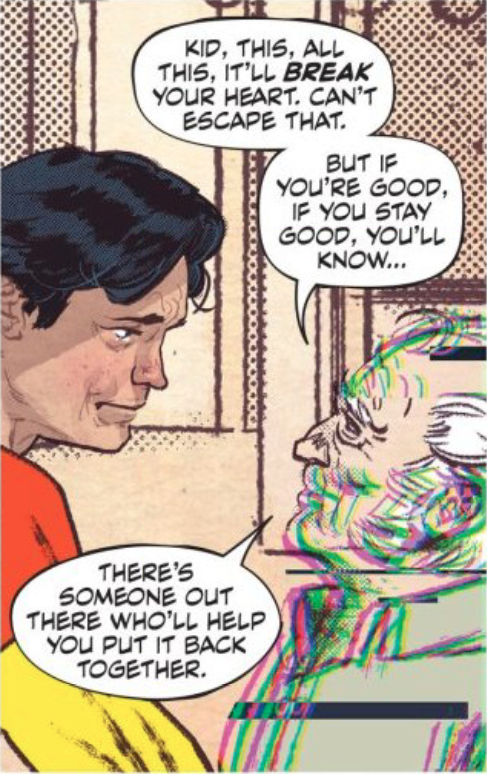
This isn’t an answer to the question of “Is this the real life? Is this just fantasy?” in regards to Mister Miracle (than answer is the latter on the grounds that it’s a sodding comic book). This is merely an explanation of Scott’s rational for why Scott chooses the world that he does. In truth, all the other arguments for Scott rejecting the world that he did are either contradictory or rooted in some level of emotional abuse. What’s more important are the people Scott’s with. Sure, sometimes they’ll argue with one another and want to tear out each others guts, but as Oberon says “Kid, this, all this, it’ll break your heart. Can’t escape that. But if you’re good, if you stay good, you’ll know… There’s someone out there who’ll help you put it back together.”
And in that, we find the final statement Mister Miracle has on the 21st Century. Not a statement of the cyclical nature of war or the wrongness of the world or even of the implications of suicide. Instead, what it offers is an answer to the question “What do you do when you are fucked?” That moment when all seems lost and there’s only pain and suffering in store for the future. What do you then? Mister Miracle answers by saying we should find those who feel the way that you do and be there for each other. Sure, you might lose. The cruelties of life might be too much to defeat in one lifetime, there might be another devil in sight and the one you slain might get up again wearing polo shirts and brandishing tiki torches. (Which, for the record, Mister Miracle on the side of “Punch them in the face,” albeit by implication) And yes, sometimes we’ll hurt each other in the process. But we can always be better. We can always listen to those in trouble. And we can always try to help one another, even if it’s just by writing some silly review.
THE FACTS
Comic issues Mister Miracle #1-12
Artists Mitch Gerads (pencils, inks, colors, and variant cover)
Other credits Clayton Cowles (letterer), Nick Derington (cover), Brittany Holzherr (assoc. editor), James S. Rich (editor)
Connected King works Most obviously Darkseid War: Green Lantern and The Visions for their themes of Godhood and Family respectively, but also Kamandi Chalange #9 and Swamp Thing Winter Special. The former deals with themes of the cyclical nature of things and why fighting is worth it even if you know you’ll fail, while the latter is about a neurodivergent person being manipulated by coldly cruel forces for their own ends.
Look Out For Ghosts, eyes, and reflections
Still to come in Mister Miracle The Prince With a Thousand Enemies! A Musical Prostitute! And E.M. Cioran!
“Depression is a disease. Make no mistake. [Lars] von Trier can romanticize it all he wants, but depression is a stasis. It’s a dead end. Succumbing to it is a surrender to death. And he can go on and on about how hollow our culture is and how shallow life is, but… what of it? I’m alive. And I can experience the new and share it. Here, now, I’m alive… And what happier thing could be said! We should all keep creating and sharing. Because, in the words of a better filmmaker: Our songs will all be silenced, but what of it? Go on singing.”
-Kyle Kallgren, Brows Held High-Melancholia (Part 2)
Long ago in an American summer...
08/11/2017-11/20/2018